AI
The Claude manual worth reading is Anthropic's IPO filing
Anthropic's shares rose 39% and fell back to five cents above the offer price in two days. The prospectus behind them is more useful to anybody paying for Claude: it says how Anthropic expects the cost of a task to move, and why the company needs it to.

Anthropic went public on 19 November. The stock was priced at $83, opened at $111.50, touched $115.10, and on its second day came within five cents of the offer price. That is a story about the AI trade, and it will be a different story next week.
The document behind it will not change. The final prospectus is the most detailed thing Anthropic has ever published about how Claude is priced, who pays for it and what the company needs to happen next. If you pay for Claude, or are deciding whether to, it is worth an evening.
What the prospectus says about the cost of a task
The filing does not talk about prices per token. It talks about cost per task, and it gives two recent examples. With Fable 5.1 in September 2026, Anthropic says it cut the cost of typical workloads by about 25%, and by up to 45% for complex coding and agentic work. With Opus 5.5 the same month, it says it cut customers’ cost per task by about 40% compared with Opus 5.
It is specific about where that comes from: “a combination of a lower price and improved efficiency, the contributions of which depend on the task.” The public price list lets you check the first half.
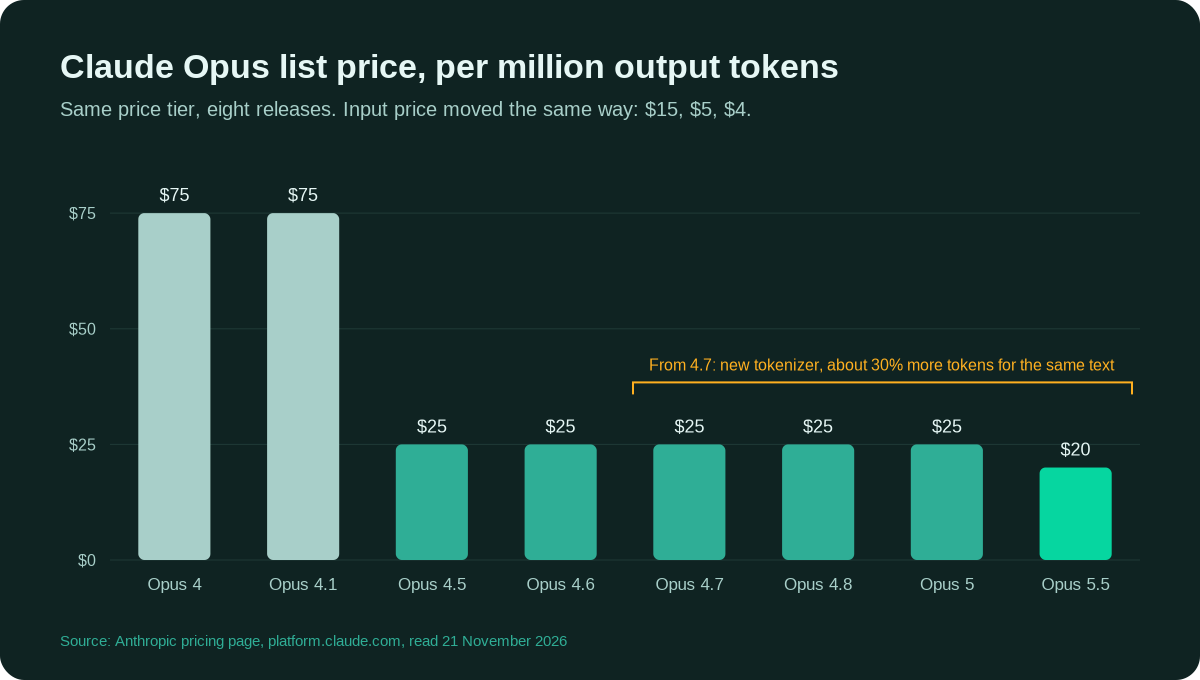
From Opus 5 to Opus 5.5 the list price went from $25 to $20 per million output tokens, and from $5 to $4 for input. That is 20%. The other half of the claimed 40% has to come from the model doing the same job with less work: fewer tokens, fewer steps, fewer attempts that go nowhere. Anthropic cannot check that for you, and neither can a price list.
The filing also shows the cuts are not marketing. Price reductions on new models and contractual discounts took about $600 million out of revenue between the second and third quarter of 2026, against about $70 million between the third and fourth quarter of 2025. And it points to what happened the last time: Opus 4.5 launched in November 2025 at a third of the old Opus price, and quarter-on-quarter revenue growth went from 48% to 132% in the following quarter.
Why per-token prices mislead in both directions
The pricing page carries a note most people skip. Claude 4.7 and later use a new tokenizer that produces about 30% more tokens for the same text. Opus 4.6 and Opus 5 have the same list price, and the same document costs more to send to Opus 5.
An illustration with public prices makes it concrete. Take one task that reads 200,000 tokens of input and writes 20,000 tokens of output, measured on the old tokenizer, and assume the new one adds 30%:
| Model | Tokens counted | Input | Output | Cost of the task |
|---|---|---|---|---|
| Opus 4 | 200,000 and 20,000 | $15 / M | $75 / M | $4.50 |
| Opus 4.5 | 200,000 and 20,000 | $5 / M | $25 / M | $1.50 |
| Opus 5 | 260,000 and 26,000 | $5 / M | $25 / M | $1.95 |
| Opus 5.5 | 260,000 and 26,000 | $4 / M | $20 / M | $1.56 |
That table assumes every model does exactly the same work, which is the one thing that is never true. A better model writes a shorter plan, calls fewer tools and does not need a second attempt, and that is where Anthropic’s 40% has to come from. The assumption is wrong in a way that is useful: it shows that list prices alone can tell you a task got 30% more expensive or 20% cheaper, and neither is what you pay.
What Anthropic needs from your usage
The second chart is the reason all of this is in a prospectus and not just in a changelog.
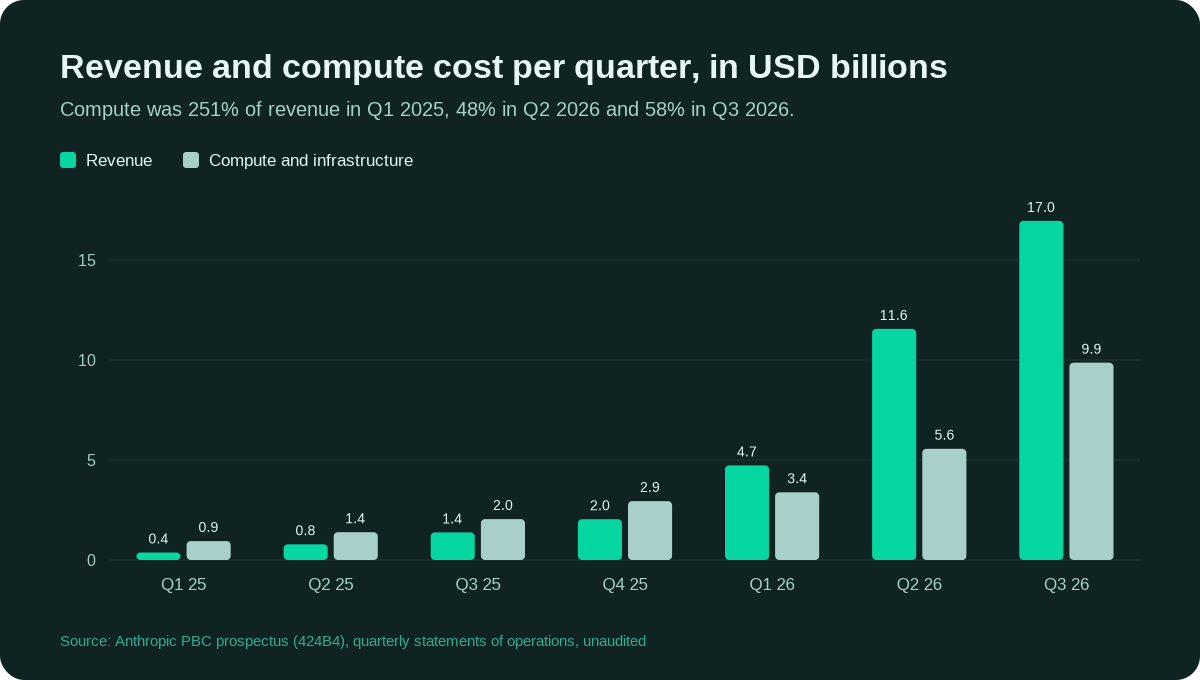
Compute cost was 251% of revenue in the first quarter of 2025, fell to 48% in the second quarter of 2026, and rose again to 58% in the third, as more contracted capacity came online. The company had its first quarterly operating profit in the second quarter and was back to a loss in the third. Behind that sit commitments of about $900.9 billion, almost all of it compute, with $70.7 billion due in the next twelve months and contracts that include take-or-pay terms. Anthropic pays for that capacity whether anybody uses it or not.
A company in that position has two ways to cover its costs: charge more per task, or sell many more tasks. So far the filing describes the second, and says plainly that it does not expect revenue to keep growing at anything like the current rate. Lower cost per task is the mechanism it presents to investors for growing usage, so it is the lever it is most likely to keep pulling. Nothing in the filing promises it, and a public company can change its mind.
The filing also shows who uses the volume. Claude Enterprise users who did not use Claude Code spent less than $75 a month on average in the third quarter. The top 5% of those who did spent about twenty times that. The money is in long, autonomous jobs, and that is where Anthropic’s products are heading.
What a “Virtual Collaborator” means for a small business
The prospectus has a term for this: Virtual Collaborators, systems that “perform complex, multi-step work at professional levels” with the access and context an organisation gives them. Claude Code is the example it leans on. Claude Cowork is the version for people who do not write code, and the filing says its adoption is ahead of where Claude Code was at the same point after release.
Read that as a sales document, because it is one. But the direction matters for planning. The tasks that get cheapest fastest are the long ones, where a better model saves whole steps, not a few tokens. A ten-second answer from a chatbot was already cheap. A three-hour job reconciling invoices, or rewriting forty product pages against a style guide, is where the next price cut lands.
The cost of that is not on the invoice. Long autonomous work needs access to your systems, and access is a decision about data and trust, not price. That is the question we spend most time on in AI development, and the reason we wrote about when it makes sense to run a model on your own hardware instead.
How to plan an AI budget when the price keeps moving
Keep one number per task, not per token: what a finished job costs, retries included. Log the tokens and the outcome for a handful of real tasks once, and you have a baseline that survives tokenizers and price lists.
Run those tasks again on every new model release. Anthropic has shipped several Opus versions in a year, and each one changed the cost of the same job in a direction you could not predict from the price page.
Keep a list of the jobs you ruled out as too expensive, and look at it after each release. Twice in the last twelve months, the cost of an Opus task fell by a third or more.
And keep the cost of switching low: prompts and workflows that do not depend on one model’s quirks, and a second provider you have tried at least once. The filing gives every reason to expect cheaper tasks. It also describes $900 billion of fixed costs, and those are the kind of thing that changes a company’s plans.
the service behind this
The service behind this
AI Engineering in detailA model is a component, not a product. We test it like one.questions
Questions about this.
Will Anthropic raise prices now that it is a public company?
Does the 40% saving apply to my workload?
How reliable are the numbers in the prospectus?
Tell us what you want to build.
Building something in this direction? Tell us what you want to build.